
Artificial intelligence (AI) is more than just a buzzword, it’s become woven into the fabric of everyday life. Picture a student searching where to go to college who is met with an AI summary at the top of the search results, or a parent typing prompts into a university chatbot to figure out when Move-In Day occurs, or a professor leveraging generative AI in the classroom to tailor feedback to individual learning styles. In all of these scenarios, you can use AI to center the needs and questions of individuals in your marketing strategy.
Why this matters
Content strategists, web developers, and brand managers play a critical role in ensuring the right information reaches the right audience. If you haven’t already, now is the time to adapt to changes being ignited by AI.
SEO and GEO directly impacts higher ed marketers. These are just a few ways:
- Large language models (LLMs) change how prospective students learn about institutions
- AI tools integrated within your website tailor responses to individual student prompts
- Search engines have shifted how alumni and donors interact with information available on your website
You’ve probably read the headlines and seen the acronym soup of AI, GEO, SEO, but let’s break down what it means for higher education marketers.
- Artificial intelligence (AI): Technology that enables computers to simulate tasks that historically require human intelligence such as learning or problem solving.
- Large Language Model (LLM): A version of AI that uses machine learning to analyze text and generate language.
- Generative Engine Optimization (GEO): A process that creates or optimizes content for chatbots powered by large language models (e.g., ChatGPT) that generates conversational responses.
- Search Engine Optimization (SEO): A process that creates or optimizes content to rank higher on search engine results (e.g., Google).
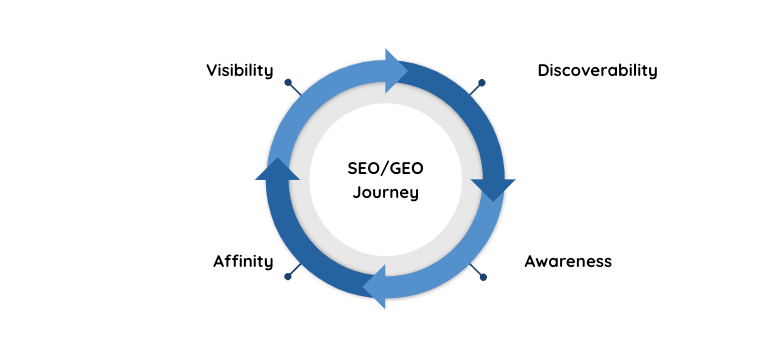
The shared purpose of SEO and GEO is to increase the number of individuals who view content that meets their needs. For someone to discover content, it needs to be visible in the spaces they search, whether that’s an AI tool like ChatGPT or a search engine like Google.
Content should be publicly visible online using terms and language aligned with specific audience needs and content goals. GEO can help people find content on both owned channels (e.g., website) or on earned channels (e.g., Reddit forums) and SEO amplifies content your organization produces and displays on your website.
Once content and websites are optimized, webpages can be crawled and discovered by search engines and AI tools, which generates awareness about your experience, service, or product.
As an individual becomes familiar with your organization, affinity grows and these engaged individuals become brand advocates by sharing their experience online, taking pictures of your service/product, or recommending your institution which boosts visibility to others.
Ways to meet audience needs using AI content strategies
To help you get started, we’ve identified three ways to leverage AI and enhance your marketing and communications strategy.
Optimize your existing web content for AI by writing for humans.
Writing content through a user-experience lens makes it easily digestible for AI tools to extrapolate information quickly. Structure your website and content so it’s easy for human readers and AI models to collect information efficiently as part of their generated responses. Identify the following opportunities to maximize existing content on your website:
- Leverage appropriate headings and subheadings
- Create scannable lists with bullet points
- Establish a clear and organized web architecture
- Write content that specifically answers questions (e.g., How do I apply to college? This is how you apply to college…)
- Use conversational language
To ensure content is conversational, use readability scores to evaluate how easy your content is to understand. Adjust the language for your audience by using a higher Flesch-Kincaid Grade level when speaking to an academic audience and a lower level when creating content for prospective students and their families.
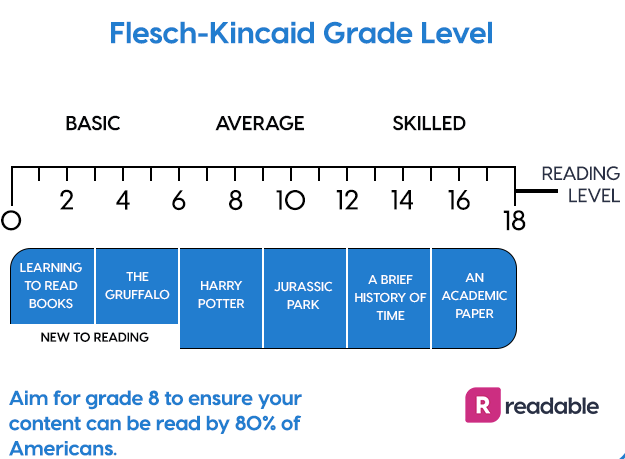
Source: Flesch-Kincaid Grade Level visual created by Readable
Amplify first-person experiences.
Ensure your web content uses an E-E-A-T format so AI-powered search engines to prioritize your content when individuals search for answers. The E-E-A-T format reflects Experience, Expertise, Authoritativeness, and Trustworthiness across the various types of content available online.
Google elevates results that are helpful, relevant to the search query, up to date, and considered accurate or trustworthy.
First-person perspectives such as testimonials, personal video storytelling, and real-world stories are examples of content Google views as trustworthy and helpful.
Video platforms and forums are increasingly important in populating AI tool responses. YouTube and Reddit currently have partnerships with AI tools to allow integrations to display summaries or previews of relevant content related to search queries. If you haven’t started already, explore how your institution can incorporate these platforms into your marketing strategy. As you’ve probably heard us say before, Reddit is more influential than you think.
Keep in mind rankings are a mix of factors and there isn’t a singular answer for how the ranking algorithm is determined. Since there isn’t a one-size-fits-all model, create balance between amplifying first-person perspectives and sharing quality, relevant content to your target audience.
Experiment and test new ideas efficiently.
AI doesn’t replace human intelligence, but it can help you augment and test new ideas efficiently. Consider ways you can lean into new ideas and use AI to enhance internal work that influences external messaging.
Write search queries and LLM prompts to better understand how your institution shows up in search engines and AI tools. Evaluate your searches to determine if a webpage needs updating, application and financial aid dates need adjustments, or headlines need rewriting to display higher in the ranking. This example of a ChatGPT test prompt answers the question, “How do I apply to [Private University]?”
![Text example of a ChatGPT test prompt that answers the question "How do I apply to [private university]?](https://blog.campussonar.com/hs-fs/hubfs/undefined-1.png?width=983&height=836&name=undefined-1.png)
Note: The name is redacted to provide an example that can be applied to any university or college.
The example demonstrates how an undergraduate student can easily scan the summary to find information. Perform your own tests and use the findings to prioritize adjustments to your web and content strategy.
Since AI overviews in search engines and tools currently don’t always provide metrics back to the website owner, it’s not surprising to see page visits decrease as more individuals use the summaries for answers. Taking a holistic approach to measuring metrics and evaluating techniques, such as tracking overall brand awareness, email campaign engagement rates, and earned and paid media metrics, can mitigate the impact of quantifying the decreased web traffic. Data collection and evaluation should be diverse to effectively evaluate the success of your marketing strategy.
Real-world examples
We’ve helped our clients strengthen and support AI integration:
- A legal advocacy organization learned how key terms identified by social intelligence findings provide insight into how individuals access free and affordable legal support services. The team identified ways to infuse the findings into their brand narrative in an effort to move away from legal jargon and toward more colloquial terms, which will ultimately optimize their website’s visibility in search and AI tools.
- A technical and community college learned how peer institutions adjust their staffing to support AI integration, supporting their advocacy for internal structural shifts and project prioritization.
- A private faith-based organization used social intelligence findings to identify relevant topics for their target audience. Focusing on the top topics positions them as a thought leader in AI responses.
A human-centered approach
The ways marketers leverage AI changes daily. During times of technological progress and fast-paced integration, it’s important to focus your efforts on serving humans who benefit from your content. Ensuring the right information is available at the right time to the right people is the foundation of communications, making AI integration a critical component for the future of your marketing strategy.